
Ezra – Ezra Rebuilds the Purity of the Worshipers (7-10)

Photo Credit: kahlich.wordpress.com

Editor’s Note: We continue our series of blogs for those who are reading the Bible with us cover-to-cover this year. Interspersed with our thoughts on our daily reading, we want to provide some tips about reading the Bible in general.

After seventy years of captivity and a change of world powers, the weak and pitiful Israel is allowed to return to a destroyed and conquered land. There they begin to rebuild the temple of Jerusalem under the leadership of two men. In this book we learn that in order to maintain that which is built, the spiritual character of the people must also be rebuilt. We look at each of these two projects as we read this book. Now we discover how …

Ezra Rebuilds the Purity of the Worshipers (Ezra 7-10)

In this section we can see:

  • Ezra the priest arrives to establish a people for His name in Israel. (Ezra 7)
  • Ezra the priest arrives to provide for the people of His name in Israel. (Ezra 8 )
  • Ezra the priest arrives to purify the people of His name in Israel. (Ezra 9-10)

There is a key lesson from this section of God’s Word: You can have a glorious worship facility and still be ugly inside before God. Purity is essential if one is to approach a holy God.

It is our hope that this background information helps a bit as you read on in the Bible.

For daily insights into the passage we are reading together each day, you can follow Dr. Smith on Twitter and on Facebook.

You can obtain more help from the FREE Bible reading schedule on our resource page. In His Image is a daily devotional that also follows our reading schedule and expresses the Biblical truth: “God Created You to Love You.” You can find this resource on the side bar of our website.

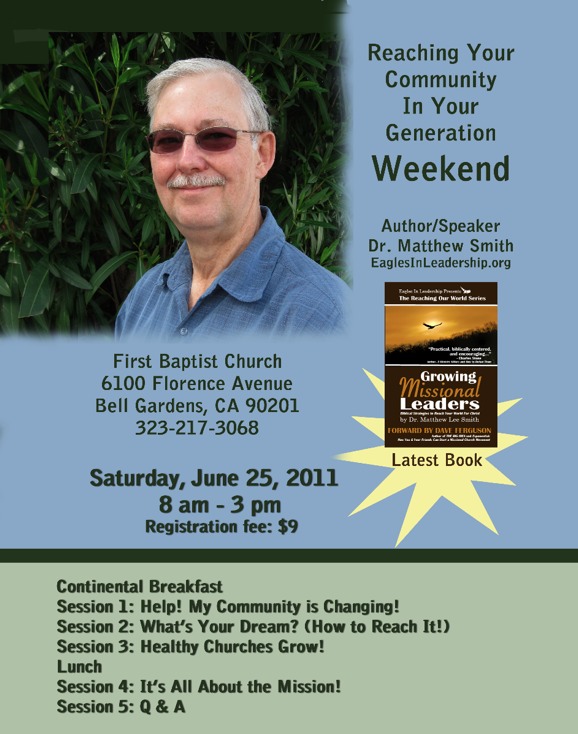
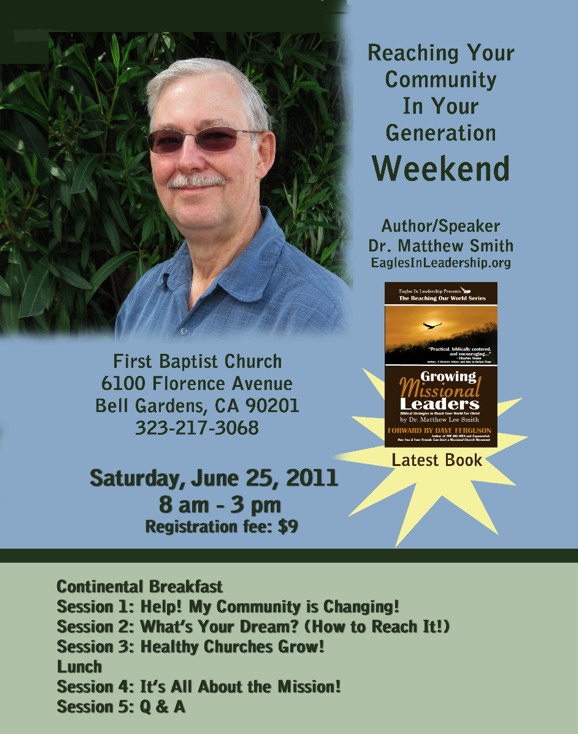
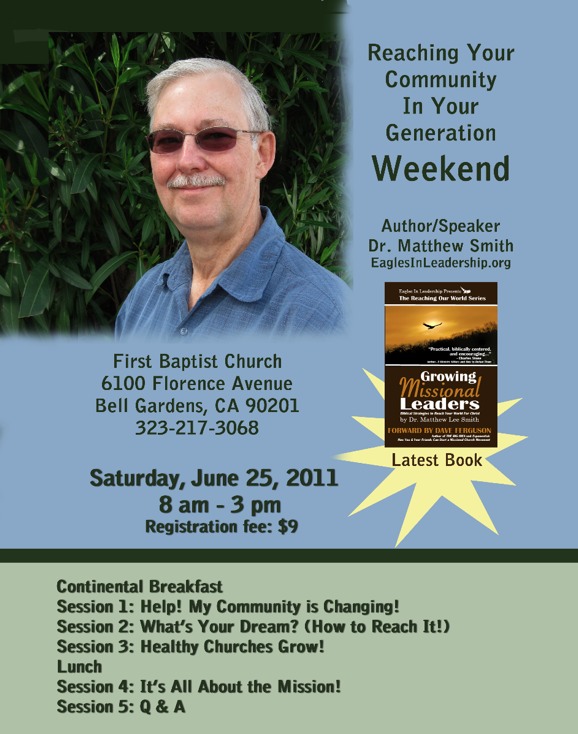
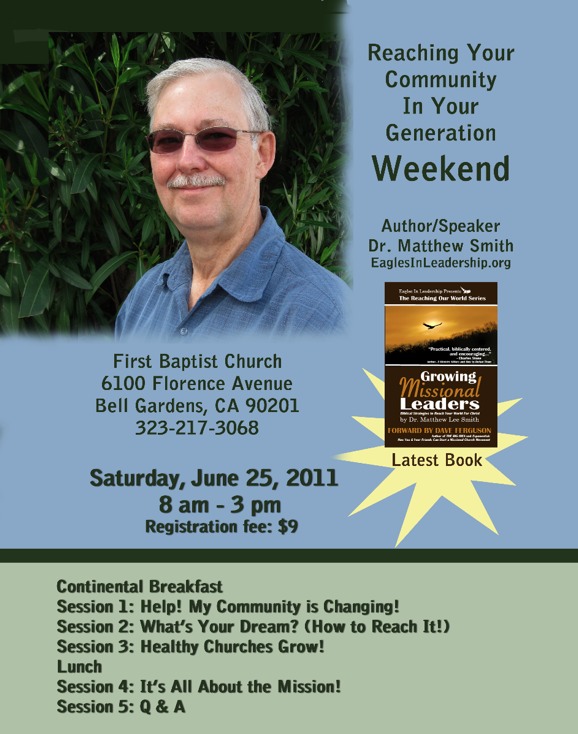
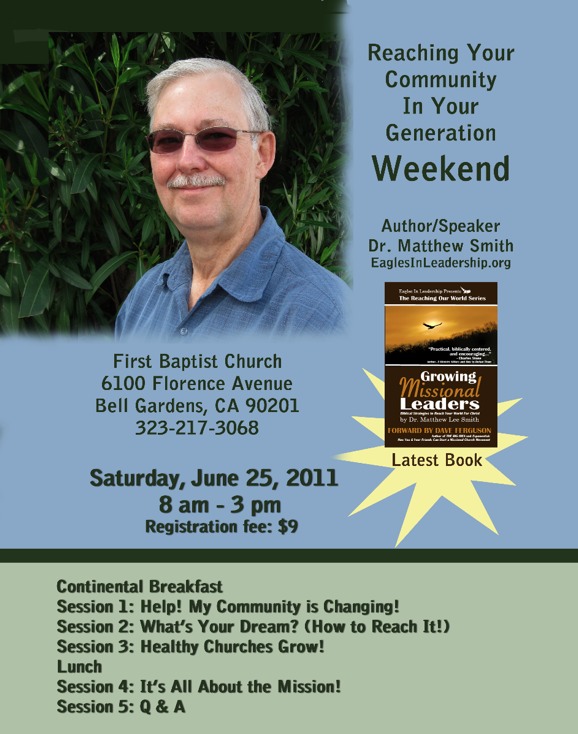
Join Dr. Smith in Bell Gardens, CA This Month!


Posted in Just Read It! | Tagged , , , , , , | Leave a comment

Cross-Cultural Ministry (Part 2)

Pastors Matthew Smith, Jacques Francios and Rafael Maria

(3 Languages, 3 Cultures, 1 Church in South Florida)

We continue our two-part series today with more strategic lesson learned on the American “foreign field.” As Melodee and I followed God’s leading for our lives, we found ourselves in multi-ethnic, multi-cultural ministries in Florida and back in Los Angeles.

What We Learned in Jamaican / Haitian / Dominican South Florida

Melodee and I have also worked with Jamaicans, Haitians and Dominicans in the Miami area, implementing many of the concepts above with similar results. While we were there, we were able to triple the attendance and reach and baptize many men, women and teens. Among the strategies we added here were:

  • A focused missional component

We intentionally began to reach out into the community, doing prayer walks and inviting our neighbors (those within a 1 mile radius of the church campus) to worship on special days – Christmas, Easter, Mother’s Day, etc.). These organized events encouraged the individuals in the congregation to be more intentional in their witness and brought many to faith in Christ.

  • A multilingual component

At first, the church was renting to a Spanish-speaking Dominican congregation and a second Haitian Creole-speaking congregation. Since we were all of like beliefs, we began the process of uniting the three congregations into one church. The unity we had when we met for worship, prayer and celebration was catching the attention of the reporters at the Miami Herald and the Sun-Sentinel, South Florida’s other major paper. This built excitement and great hope among the three language congregations.

What We Learned in Diverse Los Angeles County

We have also worked in a small church, where I was the intentional interim pastor in Los Angeles County. This church was predominantly Anglo upon our arrival. However, in a short time it became Hispanic, Black, Chinese, Japanese, Vietnamese, Thai and Estonian. One more key strategy was added in this congregation:

  • A visible multi-ethnic web presence

We wanted those who searched for a new ministry to see that we were like them racially. The pictures reflected the multi-cultural community we lived in. The posts were written in a “supra-cultural” tone, so that they appealed to all who read them. This built interest and was a successful magnet to draw seekers into the fellowship.

What We Learned Overall

As we continue to minister, we find the same principles work in every situation:

  • Love them unconditionally
  • Pray for them passionately
  • Accept them totally
  • Treat them as the equals they are
  • Befriend them by inviting them into our world
  • Live in their world (culture)
  • Love their world (culture) – easy to do when you start eating with them!
  • Become a part of their lives – their daily / weekly routine
  • Become a part of their families – their lives, events and loves

Those are the lessons God has showed us so far. What lessons has God taught you in cross-cultural ministry? Post them for all of us to see.

Posted in Leadership Blog, Multi-ethnic / Urban | Tagged , , , , , , , , , , , , , | Leave a comment

Ezra – Zerubbabel Rebuilds the Place of Worship

Artwork Credit: totallyfashion77.blogspot.com

Editor’s Note: We continue our series of blogs for those who are reading the Bible with us cover-to-cover this year. Interspersed with our thoughts on our daily reading, we want to provide some tips about reading the Bible in general.

Ezra: The Rebuilding Of Israel’s Worship

After seventy years of captivity and a change of world powers, the weak and pitiful Israel is allowed to return to a destroyed and conquered land. There they begin to rebuild the temple of Jerusalem under the leadership of two men. In this book we learn that in order to maintain that which is built, the spiritual character of the people must also be rebuilt. We look at each of these two projects as we read this book. First, we look at how …

Zerubbabel Rebuilds the Place of Worship (Ezra 1-6)

In this section we can see:

  • The end of the Babylonian captivity after 70 years of exile. (Ezra 1)
  • The return of the Israelites from captivity (Ezra 2)
  • The worship in Jerusalem restored by the Israelites. (Ezra 3)
  • The resistance to the rebuilding of Jerusalem. (Ezra 4)
  • The restoration of the Temple, which is resumed under the decree of King Darius. (Ezra 5-6)

There is a key lesson from this section of God’s Word: Even in captivity, God can move the world to give you freedom and release, if you trust him and draw close to him.

It is our hope that this background information helps a bit as you read on in the Bible.

For daily insights into the passage we are reading together each day, you can follow Dr. Smith on Twitter and on Facebook.

You can obtain more help from the FREE Bible reading schedule on our resource page. In His Image is a daily devotional that also follows our reading schedule and expresses the Biblical truth: “God Created You to Love You.” You can find this resource on the side bar of our website.

Join Dr. Smith in Bell Gardens, CA This Month!

Posted in Just Read It! | Tagged , , , , , , , | Leave a comment

Cross-Cultural Ministry Lessons (Part 1)

Melodee, Matt with Eddie and Jessica Torres

(A 23 year friendship in ministry)

Experience with Cross-Cultural Ministry

Melodee and I are hard-wired to work in a multiethnic community. God started this in Matthew in High School. “My earliest encounter with Lucho fused the desire to work with people of other races and cultures. This grew as I traveled in Mexico while in High School.”

This continued as Matthew went to College in Chicago. “God allowed me to teach in a Puerto Rican community in Chicago while at Moody Bible Institute. Leading the local gang leader, Carlos, to Christ was the confirmation of my need to work in a multi-ethnic, multi-cultural urban community. I was able to work among other races (Black, Chinese, Russian) while at Moody and found an ability to connect as I did.”

While young, Melodee wrote a report on Bolivia. While writing that report, God spoke to her and she made a commitment to work in Bolivia. While at Moody, she was able to spend a summer in Bolivia. While there, she fell in love with the people, but realized God was moving her to work with Hispanics in the United States.

Marriage and ministry enhanced this multi-ethnic, multi-cultural passion. Once married, Melodee and I worked with Hispanics in Fontana and Pico Rivera, California. It was in Pico Rivera where we found great results. Turning around a dying, urban church was a great accomplishment. We developed a long-term plan of rising up a new generation of leadership through discipleship. We started with the people we had – mostly young adults – and trained many from salvation through church leadership as ministry leaders, deacons and some as elders.

Through these experiences, we have learned a lot.

Strategies that Have Worked Well

Our strategies were simple, but they were not easy.

What We Learned in Hispanic East Los Angeles County

Among the strategies we learned and used in East Los Angeles, we employed the following effectively:

  • Lots of time getting to know and be known

This meant an intentional befriending of those in the community (which was 80+% Hispanic). This built trust.

  • Answering questions and instilling hope

This meant that we had to build on the trust we were establishing by enjoying life together and intentionally working to be open and approachable. This deepened trust and built great friendships.

  • Vision casting and “envisioning hope” in those we were friends with

This was a process of explaining who God is and what he loves to do in an urban, multi-cultural community as we become the church. We shared with them our hope and vision of them, in the years ahead, as the next generation of leadership, mature, God-led and missional. This built excitement and willingness to participate.

  • Creation of a Prayer Partners Ministry

Each pastor hand selected individuals to join his “prayer partners.” This included:

1)    Individually asking people to join the prayer partner ministry

2)    Hold an annual retreat and explain the ministry and call your prayer partners to uphold the pastor and the church in dedicated prayer

3)    Hold a prayer partners breakfast quarterly – share the vision and the needs

4)    Organize the prayer partners into weekly prayer teams

5)    Provide a standardized prayer list for the pastor to pray through the week

6)    Assign a team to pray for the pastor and the church on a specific weekend before worship by being physically present on campus together

7)    Pastor provides a weekly update of the week’s praises, needs and the weekend’s strategy and prayer targets

8)    Continue the process weekly / quarterly / annually

  • A clear “road map” to spiritual growth and development

We set down and intentionally discussed what were “producing” in our discipleship / leadership process. What did “fully devoted followers of Jesus Christ” look like when we had created one, with the work of the Spirit? When we answered this question, we sat out to place the components in place that would take a person without faith and growth them, step-by-step, into either a deacon, elder or vocational pastor, missionary or Christian leader. This built credibility, as we were one of the only churches in our community that actually published our road map and programmed to accomplish it.

  • Discipleship and leadership development

Soon these men and women were ready to grow in a more organized methodology. We started with the Purpose Driven Church model, implementing CLASS 101, 201, 301, and 401. We did individual mentoring and discipleship. I began a monthly leadership training of all leaders and servants in the church. We learned together, strategized together and prayed together. This built a young team of new leaders who began to step up and into ministry, as well as sharing their excitement with friends and inviting them to worship, and then to Christ.

  • Repetition and continued discipleship and leadership development

Since we had created a road map for every believer to follow to grow from salvation through the highest levels of leadership, people were willing to take these steps themselves, and more importantly, lead others through these steps. This built depth in numbers of leaders and in the quality of their leadership.

  • Area and regional trainings to learn

Key to growing effective volunteer leaders was the need to take them to trainings where they could see (1) they were not alone, (2) there were answers to their ministry questions and (3) the value of networking and developing valuable friendships. We have taken volunteers to Purpose Driven conference, youth ministry conference, children’s conferences and I have taken many men to Pastors conferences as far away as Moody Bible Institute in Chicago.

  • Area and regional trainings to teach

For those leaders who excelled in their leadership, we were able to take them to conferences as speakers and trainers of trainers. This was a great blessing to the individual when they realized they really were growing and could minister to the greater body of Jesus Christ. Several of the men stepped in when a local pastor took ill with cancer and filled his pulpit for two months while the church made decisions. This built courage and maturity.

In part 2 of Cross Cultural Ministry Lessons we will share more of the strategic lessons we have learned in the real world of ministry on the American “foreign field.”

Posted in Leadership Blog, Multi-ethnic / Urban | Tagged , , , , , , | 1 Comment

John Piper Interviews Rick Warren

Photo Credit: apprising.org

Full disclosure: Rick Warren is Dr. Matthew and Melodee Smith’s Pastor. We have been members at Saddleback since 2005. We believe this interview will be tremendously enlightening!

On May 1, respected author and speaker John Piper sat down with Rick Warren, pastor of Saddleback Church. Piper quizzed Warren on the doctrine surrounding his book, “Purpose Driven Life.” Piper presents Warren with direct and relevant questions about his influences, why he wrote the book, and how he defends the declarations he makes. Watch as Piper and Pastor Rick discuss topics such as the glory of God, whether negative life circumstances are caused by God, and more. This informative and inspiring interview gives deeper insight in to the author and pastor.

You may listen to the interview here.

Posted in Leadership Blog | Tagged , , , | Leave a comment

How Do You Get College Students Involved in the Church’s Mission and Ministry?

Recently I was asked, “What ways have you seen that are successful for folding college students or recently graduated college students into a larger fellowship?”  Essentially, this person wanted to know, “How do you get college age students involved in the church’s mission and min

My response included 6 key thoughts …

  • You have to answer their questions – and be open for all of their questions – including the ones you would really rather not deal with – without judgment.
  • You have to genuinely care for them. Care is spelled T-I-M-E. Love (care) is demonstrated by how much of an investment we make in another. Consider the fact that most college age adults simply drift from the faith, as explained by Drew Dyck in Generation Ex-Christian: Why Young Adults Are Leaving the Faith and How to Bring Them Back

“Fully 22 percent of eighteen- to twenty-nine-year-olds claimed no religion, up 11 percent from 1990. They also found that 73 percent of Nones came from religious homes, and 66 percent were ‘deconverts.’ ” (2010, p. 168)

  • You have to communicate through their media – we have to be able to communicate through text messages, Facebook, Twitter (and whatever media they communicate in next) in order to be in their world.
  • You have to invest in them – we have to listen to their hearts and do all we can to equip them to accomplish their dreams. From their dreams will come the new ministries of the church that will reach their generation with the love and leadership of Christ.
  • You have to train them into ministry. Many of Jesus’ disciples were in this age range – and Jesus entrusted the future of the church to them. We must train them intensively for accomplishing the ministry and let them lead – giving them on the job training as they go.
  • You have to give them a seat at the table and make room for their leadership. Without ownership, they simply walk away. (Included is a picture of Michelle Eastman, a staff member at Saddleback, as an example – note her tag.) In order to “fold in college students” we have to have an inclusive mentality and methodology of putting high school and college age men and women into leadership and on staff. We can do that through volunteer positions, internships, and part-time paid staff when appropriate. Listen to Larry Osborne’s counsel from his book, Sticky Teams:

“… young eagles are born to fly. It’s their nature. It’s how God made them. if they can’t fly high at our church, they’ll bolt and fly elsewhere. And sadly, if and when they do, they’ll take most of the life, vitality, and the future of the church with them.” (2010, p. 115)

That was my answer. I would love to hear what you would say. Feel free to write a comment and post it.

Posted in Leadership Blog | Tagged , , , , , , , , , , , , | Leave a comment

2 Chronicles – The Temple Is Destroyed By the Wickedness of the Kings of Judah (10-36)

Artwork Credit: marcohara.blogspot.com

Editor’s Note: We continue our series of blogs for those who are reading the Bible with us cover-to-cover this year. Interspersed with our thoughts on our daily reading, we want to provide some tips about reading the Bible in general.

2 Chronicles: The Spiritual Evaluation of Judah’s Kings

The old adage, “What goes up, must come down” is verified in this book. In the book of 2 Chronicles we see the glory days of Solomon’s early years and the political disasters brought about by his moral failures. This book confirms the truth; “Everything rises and falls on leadership.” Again we divide the book into two parts. Today we look at the last part of the book.

The Temple Is Destroyed By the Wickedness of the Kings of Judah (2 Chronicles 10-36)

In this section we can see:

  • Israel is torn apart under the foolishness of King Rehoboam and the rebellion of Jeroboam. (2 Chronicles 10-12)
  • Judah is strengthened under the faith of King Abijah and the victory of the Lord. (2 Chronicles 13)
  • Judah is victorious under the leadership of King Asa and the victory over the Ethiopians and the Syrians. (2 Chronicles 14-16)
  • Judah is prosperous under the godliness of King Jehoshaphat and the teaching of God’s Word throughout the land. (2 Chronicles 17-20)
  • Judah is weakened under the idolatry of King Jehoram and the alliance he made with Israel. (2 Chronicles 21)
  • Judah is humbled under the wickedness of King Ahaziah and his ultimate assassination by Jehu within the first year of his reign. (2 Chronicles 22)
  • Judah is confused under the double standards of King Joash and his later apostasy before the nation. (2 Chronicles 23-24)
  • Judah is defeated under the half-hearted loyalty of King Amaziah and his later idolatry and death. (2 Chronicles 25)
  • Judah is strengthened under the early return of King Uzziah to the Lord, however his pride led to his downfall and judgment from God. (2 Chronicles 26)
  • Judah is guided under the godliness of King Jotham, but the nation refuses to return to the Lord despite his guidance. (2 Chronicles 27)
  • Judah is desecrated under the wickedness of King Ahaz, leading to his dishonorable burial at the end of his reign. (2 Chronicles 28)
  • Judah is revived under the spirituality of King Hezekiah, despite his later selfishness, which ultimately leads to the destruction of Judah. (2 Chronicles 29-32)
  • Judah is seduced into destruction under the leadership of King Manasseh, despite his later repentance and the kindness of God shown to him. (2 Chronicles 33)
  • Judah is returned to idolatry under the failure of King Amon, which leads to his murder by his own servants. (2 Chronicles 33)
  • Judah is purified for true worship under the direction of King Josiah, who is then killed in a battle he should not have been in. (2 Chronicles 34-35)
  • Judah is conquered by the Babylonians under the reigns of Kings Jehoahaz, Jehoiakim and Jehoiachin. (2 Chronicles 36)

There is a key lesson from this section of God’s Word: You can be God’s “beloved” but you still have to walk in close fellowship with him in order to avoid the harvest of a sinful life.

It is our hope that this background information helps a bit as you read on in the Bible.

For daily insights into the passage we are reading together each day, you can follow Dr. Smith on Twitter and on Facebook.

You can obtain more help from the FREE Bible reading schedule on our resource page. In His Image is a daily devotional that also follows our reading schedule and expresses the Biblical truth: “God Created You to Love You.” You can find this resource on the side bar of our website.

Join Dr. Smith in Oshkosh Wisconsin This Weekend!

Posted in Just Read It! | Tagged , , , , , , , , , | Leave a comment

Hello Wisconsin Friends! It's All About the Mission!

You are invited to attend!

Bring a friend!

Posted in Advertizing | Tagged , , , , | Leave a comment

2 Chronicles – The Temple Is Constructed By the Workmen of King Solomon (1-9)

Artwork Credit: kenraggio.com

Editor’s Note: We continue our series of blogs for those who are reading the Bible with us cover-to-cover this year. Interspersed with our thoughts on our daily reading, we want to provide some tips about reading the Bible in general.

2 Chronicles: The Spiritual Evaluation of Judah’s Kings

The old adage, “What goes up, must come down” is verified in this book. In the book of 2 Chronicles we see the glory days of Solomon’s early years and the political disasters brought about by his moral failures. This book confirms the truth; “Everything rises and falls on leadership.” Again we divide the book into two parts. Today we look at the first part of the book.

The Temple Is Constructed By the Workmen of King Solomon (1-9)

In this section we can see:

  • Solomon knows the leadership of the nations requires great wisdom, which he asks and receives from God. (2 Chronicles 1)
  • Solomon knows the construction of the temple requires great resources, which he asks and receives from Hiram, King of Tyre. (2 Chronicles 2)
  • Solomon knows the adornments of the temple require fabulous extravagance, which he sets Huram to accomplish. (2 Chronicles 3-4)
  • Solomon knows the worship in the temple requires God’s wonderful Presence, which he asks the Lord to provide. (2 Chronicles 5-7)
  • Solomon knows the blessing of the Lord requires his complete diligence, which he sets out to fulfill. (2 Chronicles 8-9)

There is a key lesson from this section of God’s Word: Pray big prayers, expect great things from God as you walk fully, humbly in His presence.

It is our hope that this background information helps a bit as you read on in the Bible.

For daily insights into the passage we are reading together each day, you can follow Dr. Smith on Twitter and on Facebook.

You can obtain more help from the FREE Bible reading schedule on our resource page. In His Image is a daily devotional that also follows our reading schedule and expresses the Biblical truth: “God Created You to Love You.” You can find this resource on the side bar of our website.

Join Dr. Smith in Oshkosh Wisconsin This Weekend!


Posted in Just Read It! | Tagged , , , , , , , | 1 Comment

1 Chronicles – The Last Days of David

Map Credit: jesusreigns.wordpress.com

Editor’s Note: We continue our series of blogs for those who are reading the Bible with us cover-to-cover this year. Interspersed with our thoughts on our daily reading, we want to provide some tips about reading the Bible in general.

1 Chronicles: The Spiritual Life of David (about 40 years)

Remember that in this book we see the victories of King David. Missing are most of the failures we are more familiar with. Clearly the author intended for the reader to comprehend the cause-and-effect relationships between David’s spiritual lifestyle and his successes. We are breaking the book into six sections. Let’s look at the last section today …

The Last Days of David (1 Chronicles 28-29)

As David’s life comes to an end, we see him wrapping up a long-lived, God-centered life by focusing on his legacy – the next generation. As we read this section we discover that the Lord restricted David from the construction of the temple because he was a “a man of war” and had “shed blood.” (1 Chronicles 28:3)

We also discover that the Lord chose Solomon to build the Temple and promised him an everlasting kingdom if he followed close to God! Note closely the words of warning and promise given to Solomon by David:

“And you, Solomon my son, know the God of your father and serve him with a whole heart and with a willing mind, for the Lord searches all hearts and understands every plan and thought. If you seek him, he will be found by you, but if you forsake him, he will cast you off forever. Be careful now, for the Lord has chosen you to build a house for the sanctuary; be strong and do it.” ” (1 Chronicles 28:9–10, ESV)

In the final chapter, David completes his life by taking care of all the loose ends he can think of. It is a testimony of this man of God that we read in the New Testament these words:

For David, after he had served the purpose of God in his own generation, fell asleep and was laid with his fathers and saw corruption, ” (Acts 13:36, ESV, Emphasis added)

In this section we can see:

  • David instructs Solomon in how to build the temple. (28)
  • David provides Solomon with the materials to build the temple. (29)

The lesson from this section of God’s Word: Serve God’s purposes passionately, plan for your legacy and know God’s pleasure as you step into His presence.

It is our hope that this background information helps a bit as you read on in the Bible.

For daily insights into the passage we are reading together each day, you can follow Dr. Smith on Twitter and on Facebook.

You can obtain more help from the FREE Bible reading schedule on our resource page. In His Image is a daily devotional that also follows our reading schedule and expresses the Biblical truth: “God Created You to Love You.” You can find this resource on the side bar of our website.

Check out Dr. Smith’s review of Larry Osborne’s book, Sticky Teams!

Sticky Teams is a must read for pastors and church leaders who want their board, staff and church to function well in the long-term. Larry Osborne is a veteran pastor who has enjoyed a long-term pastoral relationship with North Coast Church in Northern San Diego County.

Sticky Teams aims to shore up the foundation of a healthy team, “because even the clearest vision, greatest innovations, and most stellar programs won’t make much of an eternal difference if our ministry and leadership teams are mired in the deep weeds of disunity and conflicting agendas.”

You can read the whole review here.


Posted in Just Read It! | Tagged , , , , , , | Leave a comment