Help! Our Community Is Changing! (Part 2)

by Dr. Matthew Lee Smith (c) 1999

In part 1 we discussed the rise and decline of the urban church. We ended our

Somewhere between the birth and the death of the local church selfishness took center stage, replacing self-sacrifice. From a clear goal of reaching that community with the Gospel, the church wanders in an aimlessness that brings about its death.

God has a better plan!

In September of 1988, God sent me to this dying church in East Los Angeles Country as pastor. The church was in stage six, and as I walked towards my car the evening I accepted the call, the head elder told me, “Well, I hope you can make this place go. You’re our last hope.” Driving home I had no idea of what to do or what had happened to this church. What was most intriguing to me was the demographics of our community. When the church was formed, only a few thousand people lived there, and yet a vibrant church flourished! When Melodee and I arrived the community had over 56,000 people and was struggling to survive.

That night began my long road trip towards understanding the dying, urban church. Here’s what I learned in that eleven year “on the job” training, a gift given by a gracious and patient God.

This is work, the ministry!

Stage One: Focused on Mission. As I examined the stories of the few who were still at our church at the time of its birth, they told of the excitement of winning people to Christ. In their stories came comments like: “We all got into a car and brought our friends with us to hear the evangelist at church. Two of my friends received Christ that night.” In the birth of the church there was a clear focus on the Gospel mission. Seeing people brought to Christ provided the life and energy to continue the hard work of the ministry.

Stage Two: Focused on Discipleship. As the church expanded, it did so because it taught its people to reach out and grow in faith at the same time. It hit me while sitting at a mortuary one day with a family: Churches grow because they are filled with babies! There is an incredible excitement with new life that is missing when one is constantly losing people. Just as sorrow and hopelessness often result from the death of a loved one, so too joy and enthusiasm are generated at the birth of a new child. Expansion occurred at our church because of the constant excitement of new life.

Stage Three: Focused on Leadership. As each child grows, their parents teach and train them in the skills needed at that stage of life. So too, the growing church, often out of necessity, trains more and more new converts to take over ministry. By giving away the ministry, ownership developed at our church. One old-timer Charlie, then an elder, told me, “They gave me a three-hour training and put me in charge of a group of 5th grade boys. I was terrified at first. As the weeks passed I grew more confident. Then I started to love those boys. Pretty soon all of them had received Christ, been baptized and brought a friend to Sunday School.” It is here, when new leaders are developed, that the church takes on depth. It is also at this point that the focus must once again, intentionally be refocused on mission.

Stage Four: Refocus on Mission. Here is where the invasion into the community occurs. It is at this time that those who make up the church must make a Kingdom choice. Will they stay and “do it all over again?” Attempts were made in the 1970s and 1980s to reach out to the incoming Hispanics. Some were faulty in philosophy. Others were still jaded with prejudice. It wasn’t until we were deep into stage six that we effectively did the things necessary at this stage.

We began with a Spanish-speaking service. We sought out friends who were bi-lingual. We established relationships with children who were more fluent in English than their parents, inviting them to Sunday School and our youth programs. We made them a part of our church, of our family. As we intentionally sought to reach out to the second cultural generation of our church, we would be successful. Growth came slowly at first. With every new convert came new excitement and energy. With the new faces came new music styles and new ideas. Each energized the church in new ways.

Stage Five: Refocus on Discipleship. Here we began a one-on-one discipleship program after mass teaching some 30 people in a program. Appointing a couple to head up this program made the pastor’s job easier, and shared ownership in the ministry. The church began to regain strength, slowly reversing the effects of stage six. Roofs were repaired. Buildings were repainted. New music was purchased. New life began to rise from the decay. As the team of discipled men and women grew the possibilities also grew. After one particularly successful multi-church rally, the team members sat together in the back of the sanctuary, almost unwilling to go home. Drawing out their hearts I asked, “So what are you thinking?” Debbie said, “We did it!” “And …?” I asked her. “And … it feels so good!” she said. As the old-timers “parent” the new cultural generation, the church energy, ownership and financial levels rise. Ministry to others becomes the norm again as people are praying for their unsaved friends, relatives and co-workers. New babes in Christ bring more enthusiasm.

Stage Six: Refocus on Leadership. In order to assure the stability of the church when the “old-timers” of the first cultural generation are gone, these new disciples must be trained and handed the reigns of leadership. It is at this point that the graciousness of our first generation came forth. “We aren’t going to be here forever,” Paul told me one day as he nominated a young man for a position. “It’s time they learned like we did – by doing it!” In this transformation of ministry, hearts are shared. There is no longer the destructive language of “them” and “us.” Only “we” exists. Color and nationality no longer mean anything. All are one in Christ, and all are one family in him.

Stage Seven: Re-Refocus on Mission. And so the community will no doubt change again. If we have done our job right, the second cultural generation will make the hard choice and choose to birth a third cultural generation by focusing again on the Gospel mission. Soon, many people will have received Christ from several cultures and in several generations.

A vibrant, discipling church!

In order for this process to repeatedly occur, leadership must help the people maintain a focused mindset on three gospel elements: mission, discipleship, and leadership development. When the local church acts on these three priorities, seeing those who are all around them as their responsibility, its future is bright with hope!

————-

Eagles In Leadership exists to help you and your church. Should you desire, we are here to help assist you in your leadership needs.

Posted in Leadership Blog, Multi-ethnic / Urban | Tagged , , , , , , , , , | Leave a comment

Help! Our Community Is Changing! (Part 1)

by Dr. Matthew Lee Smith   (c) 1999

With tears in my eyes, I realized God had accomplished what He had set out to do among us. Our church now looked like our urban community, over 90% Hispanic. We had intentionally followed what now was a very clear road map. It had not been easy, nor without opposition. Yet before me that Sunday was a worship center that mirrored our city. The process of change from a small, dying, predominantly white church to the vibrant and growing, Hispanic-lead fellowship was a work of God’s grace.

It ain’t pretty, just true!

As the quality of American cities declines and churches disappear, pastors and denominational leaders across our nation are asking hard and honest questions. Most of these deal with the issue of change.

Change. The word evokes many emotions: fear, trepidation, excitement, wonder and bewilderment. Community change. The phrase is a reality all too common for us. It conjures up such obstacles as aging, mobility, ethnicity, and technology. Church change. To many this phrase may seem an oxymoron. Every week dozens of congregations in America choose to dissolve compared to the few who are willing to redefine their role in a changing world.

As a whole, the Christian community for the past several decades has been more interested in the American Dream than the Great Commission. When the city goes through urbanization, the church often folds up shop and moves to the suburbs. With a pastorate of eleven years in East Los Angeles County, CA, I was able to see the stages of urbanization have their effect upon the local church. How does this happen?

The natural process of decline

Stage One: Inception / Formation. As our community began in the 1920’s, so did its optimism. In 1926, several folks came together to start a work under the American Sunday School Union. People were saved and growth was the norm. As optimism reigned, people said, “Let’s get over there!” There was the excitement of “new birth” all around.

Stage Two: Expansion. As the Bible study / Sunday School grew, people began to say in their enthusiasm, “Let’s start a church!” Eventually a new church sprouted up among the orange orchards to the east side of Los Angeles. With the birth of this new church, a more permanent platform for evangelism and discipleship in this growing community took root. Each step of growth brought the infant church into its young adulthood.

Stage Three: Stagnation. With the building of the church facilities, there came a great expenditure of energy, time and financial resources. People got tired. However, the optimism was still there and the call of the faithful was “Let’s grow our church!” As the community grew, so grew the church, often through transfer growth.

Communities however grow to a certain point and then begin to stagnate. So did our community. Affluence took over. The automobile made it easier to drive further to work and people moved again; this time out of the community. With this stagnation of the community, the church changed its focus from evangelism to edification. “Our needs” replaced the needs of others. “Middle age” symptoms had set into the church as a whole.

As John Ortberg says, “It is possible for a church to go 20, 30 years or more without producing fruit. People are not challenged, volunteers not trained, resources not well-stewarded – and no one complains (Leadership, Spring 2000. 29).”  This is stagnation at its clearest.

Stage Four: Invasion. The inevitable demographic change then occured as “white-flight” took its toll. “They” arrived. Whether that is the Hispanics, as we experienced, or the Chinese, Koreans, Iranians, etc., “they” arrive in increasing numbers. Soon the church was supported by “long-haul” Christians who lived in the suburbs and commuted to church property on Sunday. Increasingly, the local church looked less and less like its community. At this point, a clear message was proclaimed quietly: “Let’s close our church to ‘them’”. The church became more like a Country Club and less like a Rescue Station. Like parents whose grown adults return to cramp their new found freedoms, these immigrants caused prejudice to rear its ugly head.

Stage Five: Evacuation. “Let’s flee out church!” became the cry. People admitted their fears of the “way the neighborhood is going.” We heard people say, “This used to be such a nice community.” Our church felt the deepest wounds of evacuation in the 1970s and 1980s. Even the long-haulers began to drift away and the church went through a period of decline. The heart for evangelism had been lost and the masses all about the church facility were almost ignored. As the old-timers went into retirement, having done their bit for God and Kingdom, the church suffered deeply. We became a church of extremes with several very young families and several very old families. Only those who were unable or unwilling to get out of town remained behind.

Stage Six: Deterioration. A lack of people means a lack of finances and people to work on the facilities. Services, suffering from a limited pool of talent and ministries, were curtailed or terminated. I can remember the church organ sat on the platform for five years – never being played in all that time for lack of someone to play it – before we decided to remove it. Selfishness had borne its fruit and those long gone had forgotten about “their” church. Now in the midst of survival hope was lost. The church was now in its “old age.”

Stage Seven: Degradation and Death. In most churches, defeat comes when the few who have attempted to “hold out” now admit the cause is lost. With a heavy heart the dissolution clause is enacted and the church facilities are sold. With the sale comes the loss of the new cultural community for Christ.

Somewhere between the birth and the death of the local church selfishness took center stage, replacing self-sacrifice. From a clear goal of reaching that community with the Gospel, the church wanders in an aimlessness that brings about its death.

But God has a better plan!

And we will talk about that next Monday in part 2!

————-

Eagles In Leadership exists to help you and your church. Should you desire, we are here to help assist you in your leadership needs.

Posted in Leadership Blog, Multi-ethnic / Urban | Tagged , , , , , , , , , , | Leave a comment

What Do Those Without Faith Do in Times Like These?

Recession – layoffs – tightening budgets. All three of these are now very familiar at the Smith home. As I enter my seven-month without a full-time paycheck, I stopped this past week to reflect on the bounty and reality of God’s presence in our lives.

Since I am a career pastor, I am not eligible for unemployment. The churches I have had the privilege of leading have not participated in that program, classifying me as a ‘self-employed’ worker.

Yet, without a steady fulltime income, God has been amazing. And this reality has brought me to a startling realization …

What do those without faith do in times like these?

As I thought more, I came to four conclusions in this realm.

1.     Those without faith have no God to trust in.

If you are alone, apart from a God who cares and intervenes in your life, where do you go? How do you keep your sanity and remain at peace in the midst of the mess? Amazing God – that’s who I trust in. Some examples?

In ‘one of the coldest summers on record’ in Southern California, God has made it so that we have had to only run the AC at home 6-8 days all summer! In that same home, God has moved the heart of our unsaved landlord to cut our rent by almost 60% – starting this past March and extending until mid-January 2011! And God has allowed us to receive $125 in rewards cards from our bank for using our credit and debit cards (paying the credit cards off at the end of each month to our bank’s total loss).

Since we continue to tithe and give sacrificially to the needs of others, we claim Philippians 4.19 in faith: “And my God will supply every need of yours according to his riches in glory in Christ Jesus” (ESV).

Another conclusion …

2.     Those without faith have no spiritual family to work with.

Granted, most of us have some nuclear or extended family to help us out from time to time. But that can get old fast and their resources may not be any better than ours in our time of need. We have watched God provide for us from members of the body of Christ from Florida to California in these times of need. He has moved in the hearts of three people to give almost $1,000 in one week this last month to meet very urgent needs! (One friend reminded us that it was fitting that we had recently received $500 to help pay our rent from a sister in Christ since last year we had sent them a check for $500 for their mortgage in a particularly difficult time.)

And did I mention I love steak? On August 24th I tweeted, “Just back from a wonderful dinner at Outback, compliments of good friends Tom and Hope Reed. Good friends, good food and good fellowship!” Their words of love and their extravagant generosity fed our stomachs and our souls!

A third conclusion is …

3.     Those without faith have no Word from God to feed on.

As I reflect on God’s perpetual care for us, repeatedly it is His Word that brings amazing hope and help. Each morning’s devotions seem to bring a new thought, a new hope or a new word of encouragement.

When I have been tempted to whine and complain, it has been God’s Word that pulls me back and keeps me on track. Consider this recent tweet: “ACT LIKE DAD! I didn’t say any of this on my own. God sent me & told me what to say. You’ve been listening 2 God speak, not Jeremiah.” (Jer. 26.15, Msg).

The richness of the living Word of God sustains me when I drift into worldly complaint or criticism.

And finally,

4.     Those without faith have no Spirit to comfort from.

At a recent pastor’s meeting a friend of mine asked me point blank, “Why aren’t you freaking out?” I told him what I tell everyone … I have served Him for 30+ years and he has never let me down. Why should I doubt him now?”

It is in the quiet hours, the dark hours before I fall asleep that the Spirit speaks. In those hours, when I pour my heart and soul out before God – asking, ‘When and what should I be looking at? Where is Your hand moving and what do you want me to be doing?’ – in those times, the Spirit comes alongside and shares his love and care, God’s presence and power at work behind the scenes.

One night awhile back, I told the Lord the bills were now his problem! I had sent out lots of resumes, only to either never hear anything or get the ‘Thanks, but no thanks’ responses. As I explained to God, I would keep being faithful sending resumes and following leads, but our financial needs were his problem now, the Spirit said, “Your financial needs have ALWAYS been my problem. You work for me. You’ve given your whole life for me. I’ve got you covered!”

Peace and rest came over me at that moment and has remained ever since.

So, what do those without faith do in such times? I am not sure, but it motivates me to share God’s amazing story and invite them into a personal relationship with him. How about you?

Posted in Leadership Blog | Tagged , , , , , , , | 2 Comments

EIL Interviews Dave Ferguson on 'Exponential'

We are thrilled to welcome Dave Ferguson back to the Transformed podcast today! Dave and his brother Jon have written a new book entitled, Exponential – How you and your friends can start a missional movement.” We, at Eagles In Leadership, believe this book is a ‘game changer’ for the church and its accomplishment of the Mission of Jesus Christ.

In this interview, Dave discusses …

  • How the book Exponential is truly ‘all about the mission!’
  • The 3 questions one needs to ask to discover what God is up to in your world.
  • The fact that vision becomes compelling when you start sharing the ‘God-things’ with others.
  • How important it is to be affirmed when it comes to doing the mission of Jesus and to be told ‘you can do it!’ by others.
  • The huge take-away concept of every leader becoming a reproducing leader.
  • How no one is allowed to move up in leadership at Community Christian Church if they have not reproduced themselves.
  • The leadership path that is  the dynamo of the entire Exponential movement.
  • The idea of an apprentice; what is an apprentice and how does this work?
  • How this reproducing concept becomes essential when it comes to artists.
  • What Dave and Jon mean by ‘reproducing tribes’ and how is that essential for fulfilling the mission of Jesus and creating a movement of God’s people.
  • From these tribes, one moves forward to reproducing larger communities of faith and then movements to accomplish the mission of Jesus.
  • The details of going through these stages creating a movement that is all about having a ‘reproducing mindset and strategy’ as part of the church DNA.
  • And so much more …

You can check out the book and order a copy of the book Exponential here.

You can check out the Exponential book videos here.

You can check out Community Christian Church here.

You can read Dave’s Blog here.

You can check out the New Thing Network here.

Posted in Interviews, Multi-ethnic / Urban, Transformed | Tagged , , , , , , , , | Leave a comment

Steve Reynolds Talks About a 'Bod4God'!

What a joy to welcome Steve Reynolds to the podcast today. Steve has served as the senior pastor of Capital Baptist Church in Annandale, Virgina sine 1982. He launched a weight-loss campaign in his church and community after he lost more than 100 pounds.

Steve had been overweight all his life. In fact, he weighed more than 100 pounds in the first grade! After playing football during high school and college, he vowed never to exercise or run laps again. That was one promise he kept, ballooning to 340 pounds and staying there for years.

Driven by his declining health, Steve began to study Scripture. He discovered four keys to unlock the door to health and fitness.

Dr. Matthew Lee Smith of Eagles In Leadership recently spoke with Steve about how we can ‘start losing and start living.’ In this interview Dr. Smith shares some of his successes as well using Steve’s methods.

You can purchase a copy of Bod4God here.

You can learn more about Steve Reynolds ministry here.

Posted in Book Reviews, Interviews, Transformed | Tagged , , , , | Leave a comment

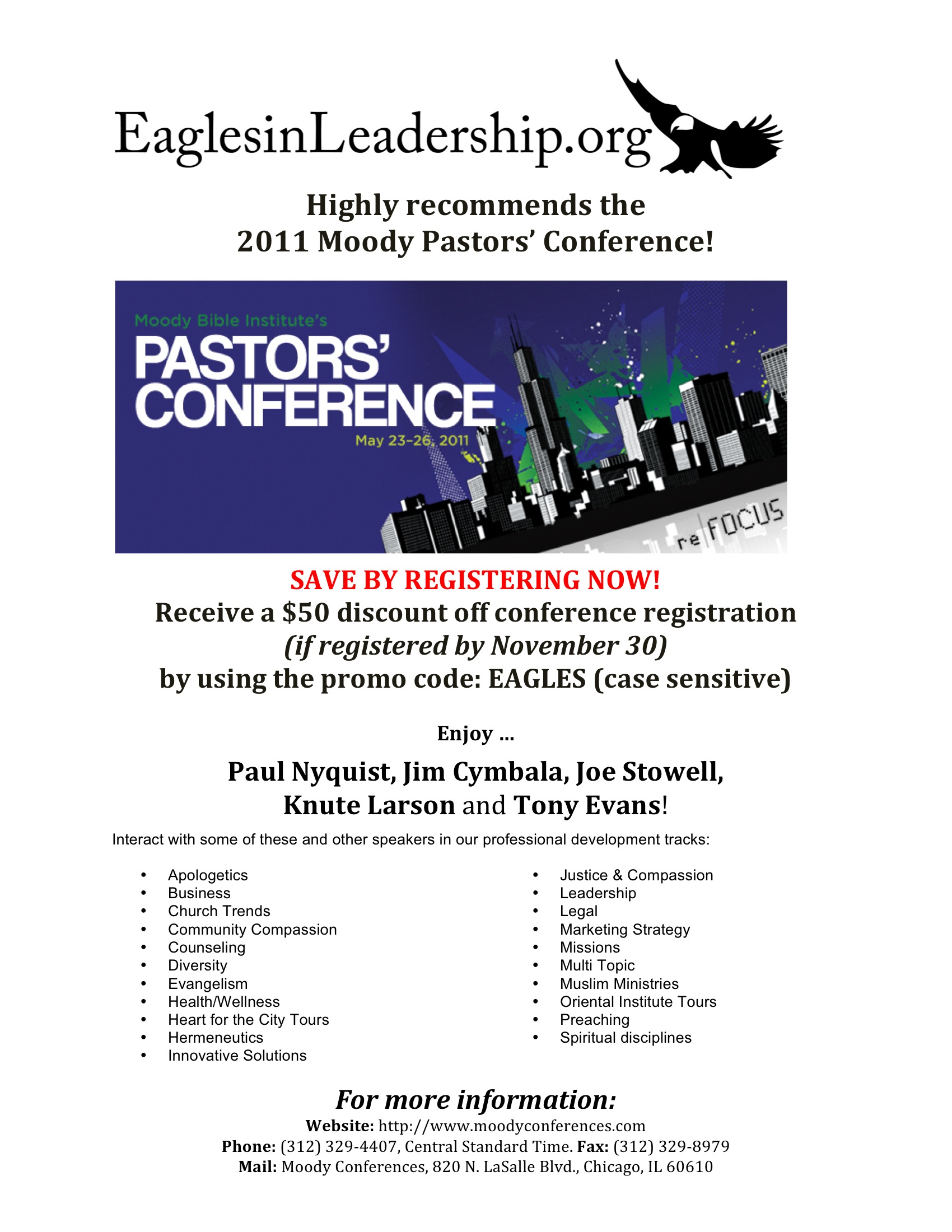
Save Now on Moody Pastors' Conference 2011!


Posted in Advertizing | Tagged , | 2 Comments

EIL Interviews Clayton King on 'Dying to Live'

We are thrilled to welcome Clayton King to the podcast today. Clayton is a pastor, evangelist, missionary and author. Today we talk about his new book, Dying to Live.

Dr. Matthew Lee Smith of Eagles In Leadership spoke with Clayton a few days ago about ‘abandoning yourself to God’s bold paradox’ and what it means to ‘die in order to live.’ We know your spirit will be excited as you listen to this interview.

Clayton has been dedicated since age 14 to proclaiming the gospel and calling Christians to live out the life of Jesus. As founder and president of Crossroads Worldwide, he has spoken to millions of people in 30-plus countries and helped organize missions to such places as Haiti, the Himalayas and India. Clayton loves good books, the outdoors, strong coffee, dirt bikes and four-wheelers, and especially his wife and children.

We heartily recommend that you purchase Dying to Live here.

You can learn more about Clayton King here.

Posted in Book Reviews, Interviews, Transformed | Tagged , , | Leave a comment

The Cancer of Complaining

by Dr. Matthew Lee Smith

“Must you always complain!” I wanted to say. There I was again, listening to another person who seemed to have the spiritual gift of complaining. This one was taking it to an art form!

“Now the when people complained in the hearing of the Lord about their misfortunes, the Lord heard it and his anger was kindled. Then the fire of the Lord burned against them, and consumed some outlying parts of the camp.” Numbers 11:1 (New Revised Standard Version)

How often do we forget that the Lord hears all, including our complaining. Even less often do we think about the emotional response our complaining brings to the Lord. Here, we discover that our complaining kindles the anger of the Lord!

As the redeemed, we are to be different! We are to have a spirit about us that personifies …

“the wisdom that is from above is first pure, then peaceable, gentle, willing to yield, full of mercy and good fruits, without partiality and without hypocrisy.” James 3:17 (New King James Version)

One of the keys to this spirit of wisdom is expressed by Paul when he says …

“Not that I speak in regard to need, for I have learned in whatever state I am, to be content.” Philippians 4:11 Emphasis mine. (New King James Version)

When the cancer of complaining infects to true Christ-follower, we must admit it is not pretty! Yet we are able to change our perspective and focus our attitudes! That is the difference that separates us from the unredeemed. We have the Holy Spirit’s supernatural presence and power to transform us.

“A drowning man does not complain about the size of a life preserver.” When I read this quote several years ago I was reminded that any time I complain I am simply ungrateful! Ungrateful to God for His wisdom and will in my life. Like the current cliché, “All I need is some cheese to go with my whine!”

My youngest daughter, Hannah, collects the Eeyore character, out of the Winnie the Pooh cartoons. She has several of them. Best known for his “gloom and doom” spirit, Eeyore always sees the gray cloud in every silver lining!

How often do we, as the children of God, draw the rain clouds about us? Whining and complaining begins to take its toll on us. People no longer stop by. After all, who wants to spend their time under a rain cloud? Pretty soon, we find our list of friends smaller than the number of fingers on our right hand. Or as John Peers puts it, “The squeaky wheel doesn’t always get greased; it often gets replaced!”

Consider yourself for a moment. Do you claim the Name of Jesus? Then another thought if you would. Do you possess an attitude of gratitude or are you caught in a rumbling of grumbling?

Perhaps you will be as warned from our Father who is “the same yesterday, today and forever” as I was when I read these words:

“The carcasses of you who have complained against Me shall fall in this wilderness, all of you who were numbered, according to your entire number, from twenty years old and above.” Numbers 14:29 (New King James Version)

Beware the cancer of complaining! Surely Lucifer is afoot! Instead …

“draw near to God and He will draw near to you.” James 4:8 (New King James Version)

If you will, then it will be said of you …

“the disciples were filled with joy and with the Holy Spirit.” Acts 13:52 (New King James Version)

To God be the glory!

Posted in Complaining, Leadership Blog | Leave a comment

7 Issues That Determine Church Size

At its inception, the church was a Mega-church (Acts 2). Granted, as it was being planted it started small (the twelve), but it grew (the 70) until it reached a solid core (120). Bathed in prayer and empowered by the Holy Spirit, Peter preached and the Church of Jerusalem grew to 3,000 plus in membership. Over time, the size of the church continued to grow as it followed Jesus’ commands.

As many of you know, Melodee and I are currently in between ministries and seeking God’s next step for our lives. As we look for and listen to various opportunities, we have detected some areas that resurface in our investigations. Each area seems to determine the size of the church we investigate.

The issue of theology – “Fortress Mentality” or “Great Commission” oriented: How a church views God’s Word impacts a whole gamut of attitudes and actions. Theology that sees the church losing the battle in the grand scheme will regress and seek to escape from the world. On the other hand, a church that sees a victorious Christ and a mandate to conquer the world will forge their mission into every area of their world.

The issue of methodology – regressive or progressive: Theology influences and often breeds methodology. When the church fears the coming invasion of evil its methods are survival in nature. If a church believes the power of the invincible Christ, their methods are heroic at least!

The issue of focus – ingrown vs. outwardly focused: Closely related to the issue of methodology is the issue of focus. As the years pass by, “Fortress Mentality” theological and regressive methodological issues take their toll. No longer – if they ever did – does the ingrown church look to reach the lost no matter the cost. However, if our theology reverberates with the God of love and the call of his heart from the beginning: “Adam, where are you?” the church will do all it can to reach the lost.

The issue of change – entrenched or willing: Key to church size is the issue of change. While the Gospel never changes, culture and receptivity issues are always in flux. Since the world around us is changing every 18 months or so, being willing to reach out to those without Christ using innovation in a relational manner is critical to growth in the local church.

The issue of demographics – sparsely vs. densely populated: A church can only grow as large as the population of their surrounding community. Rural churches may remain small because of this limitation. However, in a larger city or metroplex, a small church indicates another issue.

The issue of preferences – my likes vs. my sacrifices: Often, at the core of small churches, is the issue of preferences. Usually, a powerful group holds on to the reigns of the church – wreaking unholy havoc and throwing temper tantrums when anyone desires to change something not to their liking. The obvious result of such an approach is division, strife and shrinkage. Growing churches, on the other hand are willing to reinvent themselves and put the needs of the community before their own; thus, growth happens.

The issue of generosity – misers or generous: Sometimes church growth is directly tied to the generosity of its membership. The mission of Jesus is only accomplished when a significant number of God’s people reject the affluent lure of our culture and sacrifice their time, talents and treasures so that their church has the resources to accomplish the mission of Jesus.

While this list is not exhaustive, it is suggestive. It is quite possible that while you were reading this ideas and experiences came to your mind. Would you like to add to this list or share your experience? Please feel free to comment …

Posted in Leadership Blog, Multi-ethnic / Urban | Tagged , , , , , , , , , , , , , , , | 2 Comments

Ed Stetzer Talks About Transformational Churches!

Churches committed to following Christ’s example want this world changed for the sake of eternity. While the supernatural piece of making that happen goes without saying, how does a body of believers do its part to be in that “sweet spot” where true spiritual transformation occurs?

In Transformational Church, best-selling research authors Ed Stetzer and Thom S. Rainer survey fifty thousand churches—then narrow the scope down to five hundred congregations—for a qualitative answer. Their book, the most comprehensive study of the modern American church to date, contains a wealth of indispensable new data, nuanced insights, and how-to guidance, all centered on this key finding:

“Transformational churches make disciples whose lives are being transformed by the gospel, so that people engage the culture around them for its ultimate transformation. Deeply committed to the essential foundations of discipleship (worship, community, and mission), transformational churches practice their faith and make disciples through vibrant leadership, prayerful dependence upon God, and relational intentionality. And they do so paying mind to their unique context and with a missionary mindset.”

About the book …

Dr. Smith says, “YOU SHOULD BUY SEVERAL COPIES OF THIS BOOK! I have read at least 100 books on the church in my ministry years. It is not a stretch to say that this book is biblical, practical and well researched. The weaving of the seven traits of transformational churches is well balanced by stories and explanations, without providing programs and ‘reproducible templates’ by which the cultural nuances would be lost in their reproduction. This is an excellent book and a powerful read for those who are serious about the church in the coming decade or more. Thank you for beginning the discussion and reviving hope for the church. I look forward to more on this!

“Transformational Church should be the first book you read this year if church health and growth are your priorities. Ed Stetzer and Thom Rainer have written one of the most researched, biblical, practical and hopeful books on the church in years!”

~ Matthew Smith, founder and director of Eagles In Leadership

You can order your copy of Transformational Church here.

About the Authors …

Ed Stetzer is director of LifeWay Research and missiologist in residence at LifeWay Christian Resources in Nashville, Tennessee. He holds two masters, two doctoral degrees, and has written dozens of articles and acclaimed books including Planting Missional Churches, Breaking the Missional Code, Comeback Churches, and Lost and Found. Ed and his wife have three daughters.

Thom S. Rainer is president and CEO of LifeWay Christian Resources, one of the largest Christian resource companies worldwide, and the best-selling coauthor of Simple Church, Essential Church, and Simple Life. Rainer and his wife, Nellie Jo, have three grown sons and live in Nashville, Tennessee.

Posted in Book Reviews, Interviews, Multi-ethnic / Urban, Transformed | Tagged , , , , , , | Leave a comment